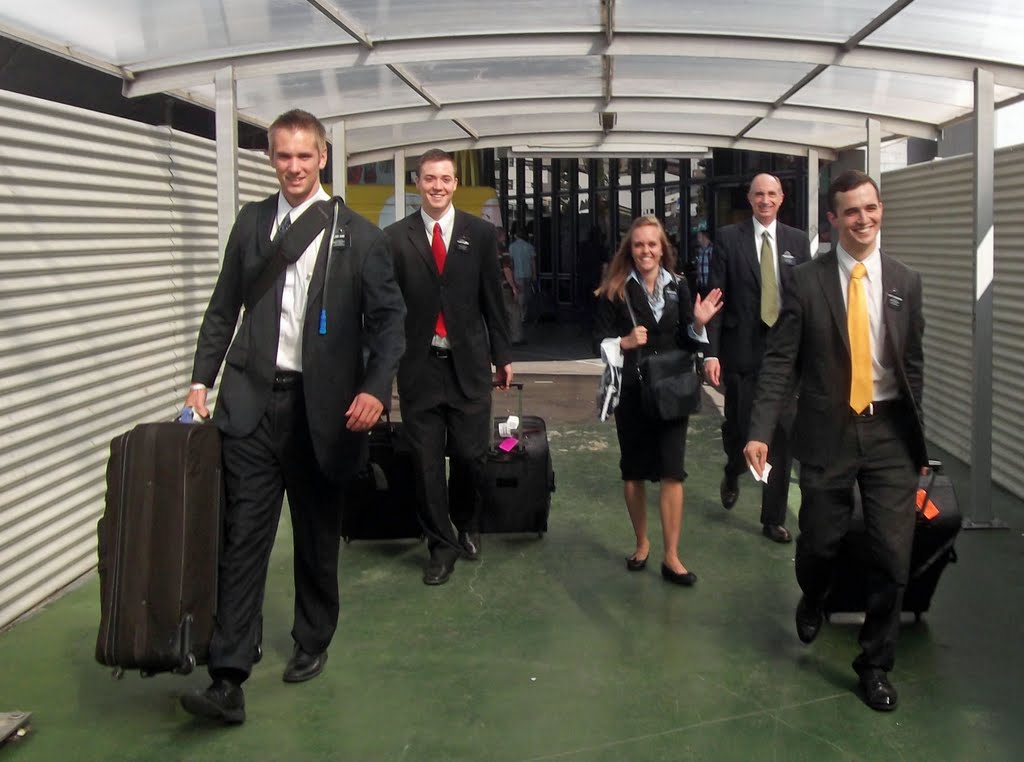
Letter from President Hinckley to All Missionaries:
LA MISIÓN ESPANA BARCELONA
Christopher
Columbus
and the
Opening of the Last Dispensation
As the sun sank below the western horizon of the Atlantic
Ocean on the evening of October 11, 1492, it left three small wooden ships
surrounded by the gathering darkness. The ships were located at latitude of 24
degrees, slightly south of Key West, Florida, and a longitude of about 73
degrees, about 3500 miles west of San
Sebastian, The Canary Islands. In all of recorded history, there was no known
record of any ships sailing so far west from land, certainly not in the broad
Atlantic.
The two smaller ships, the Niña and the Pinta, were
captained respectively by Vicente Yañez Pinzon and Martin Alonso Pinzon, two
brothers from Sevilla Spain who were experienced captains. The third and
largest of the ships, sometimes known as La
Gallega (having been constructed in Galicia) but named the Santa Maria by her devout captain, was
under the command of a 45-year old Genoese seaman who used the Spanish version
of his name, Cristóbol Colon. In English speaking countries he is known as
Christopher Columbus.
As darkness set in, the ships were at full sail in gale
force winds, traveling due west at about 9 knots. It had been 35 days since
they had last seen land – the small port of San Sebastian in the Canary Islands
where they had repaired a damaged rudder on the Niña. The voyage had already become the longest known journey
through open ocean.
About 10:00 o’clock in the evening, an hour before moonrise,
Columbus was standing on the sterncastle of the Santa Maria, scanning the dark horizon, when he thought he saw a
faint light in the distance. Not certain in the darkness if it might be land,
he did not inform his crew, but he mentioned it to an aide, Pedro Gutierrez,
who thought he saw it to. The little fleet continued to sail due west under
full sail.
At 2:00 a.m. on October 12, Rodrigo Triana, a 23-year old
sailor from Sevilla, was atop the lookout on the Pinta. In the light of the moon, he saw “something like a white
sand cliff gleaming in the moonlight on the western horizon, then another, and
a dark line of land connecting them” (Samuel Elliot Morrison, Admiral of the Ocean Sea, p. 226). Recognizing land, he
cried out to the deck below, “Tierra! Tierra!”
In that moment the world changed. One era – an era that
covered nearly 4 millennia of recorded history – ended, and a new era began.
The known world, which had consisted of Europe, Africa, and Asia, expanded to
include a New World previously unknown, and the discovery would arguably have a
more profound impact on the world than any discovery before or since. In the
dim light of the moon on that fateful morning of October 12, 1492, Rodrigo
Triana saw not just a slip of land on the horizon, but the dawn of a new dispensation
and the fulfillment of prophecy.
The written story of Columbus begins nearly 2,000 years
earlier in the deserts of Arabia, “in a valley by the side of a river of water”
(1 Nephi 2:6). In this remote location, somewhere near the Gulf of Aqaba, Lehi
and his family lived in a tent after leaving the city of Jerusalem. During
their stay in the desert, the young Nephi was given a great vision in which he saw
scenes from the history of his descendants as well as events leading up to the
restoration of the gospel in the last days. Nephi gives us only a brief account
of these latter-day events, beginning with this interesting verse:
And I looked and beheld a man among
the Gentiles,
who was separated from the seed of my brethren by the many waters; and I beheld the Spirit of God, that it came
down and wrought upon the man; and he went forth upon the many waters, even
unto the seed of my brethren, who were in the promised land. (1 Nephi 13:12, emphasis added)
Columbus, of course, did not have access to Nephi’s
prophecy, but by his own account his world-changing voyage of discovery was the
result of being “wrought upon” by the Spirit:
With a hand that could be
felt, the Lord opened my mind to the fact that it would be possible to sail
from here to the Indies, and he opened my will to desire to accomplish the
project. This was the fire that burned within me.
All who found out about my
project denounced it with laughter and ridiculed me. All the sciences … were of no use to me. Quotations of learned opinions
were no help… Who can doubt that this fire was not merely mine, but also of the
Holy Spirit who encouraged me …urging me to press forward? (The Libro de las profecías of
Christopher Columbus, translation and
commentary by Delno C. West and August Kling)
Like
Columbus, you are engaged in a life-changing adventure. You may meet with many
obstacles, as did Columbus, but the work you do will have eternal impact. Like
Columbus, the learning of the world is of little use to you – it really doesn’t
matter how smart you are, how talented you are, or how well you speak. What
matters is the fire that burns within you, urging you to press forward!
May that same fire that burned
in the heart of Columbus burn within every missionary in the Spain Barcelona
Mission,
Pte. Clark B. Hinckley
Columbus Day 2011
 |
| Christopher Columbus Statue, Barcelona |